MURA · THE COLLECTION · CLAUDE MONET
Waterloo Bridge, Sunlight Effect
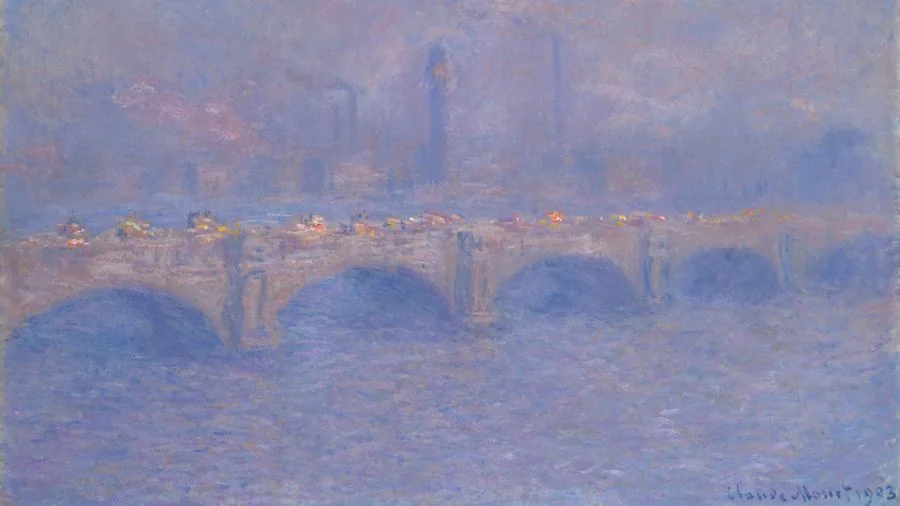
Waterloo Bridge in morning sunlight, seen through the smoke of London from a fifth-floor window of the Savoy Hotel. Claude Monet dated the canvas 1903, but the Art Institute of Chicago believes he began it in 1900 and dated it only when he was satisfied that it was finished.
Claude Monet · 1903 · Oil on canvas · Impressionism · story written 25 September 2026
What you are looking at
The stone arches of Waterloo Bridge cross the picture in a band of violet and gold, with the chimneys of the south bank behind them and the sun breaking through the haze onto the water. The Art Institute quotes Monet on the city: "If not for the fog, London wouldn't be a beautiful city. It's the fog that gives it its magnificent breadth."
How it was painted
The museum describes his routine: "he rose early every day to paint Waterloo Bridge in the morning, moving on to Charing Cross Bridge at midday and in the afternoon", observing both "from his fifth-floor window at the Savoy Hotel". The Art Institute's two Waterloo Bridge paintings are dated 1900 and 1903, "but both were likely begun in 1900 and dated only when Monet felt that they were finished". He reworked all the London canvases in his studio at Giverny and refused to send any to his dealer "until he was satisfied with them as an ensemble". They were shown together at Durand-Ruel in Paris in May 1904 under the title Vues de la Tamise à Londres; this one was catalogue number 18, "Effet de Soleil".
Where it went
Durand-Ruel bought it from Monet on 11 May 1904 for 9,000 francs and sent it to New York at the end of the year. It was lent to Boston in 1905 and came to the Art Institute in the Mr. and Mrs. Martin A. Ryerson Collection. It hangs in Gallery 243.
Why it is in Mura
Sunlight effect is the rarest weather in Monet's London. Mura keeps it beside the foggy Charing Cross Bridge so that the two can be seen as one morning and one afternoon at the same window.
Sources
- Art Institute of Chicago: Waterloo Bridge, Sunlight Effect, object record · read 24 September 2026
- Wikipedia: Charing Cross Bridge (Monet series) · read 24 September 2026
- Wikipedia: Claude Monet · read 24 September 2026
- Image record (Art Institute of Chicago) · Public domain / CC0
Mura is an art app for Apple TV and iPhone: museum masterworks by Monet, van Gogh, Hokusai, Turner and Renoir, shown one at a time, each with a story to listen to.
Get Mura for Apple TV