MURA · THE COLLECTION · CLAUDE MONET
Water Lily Pond
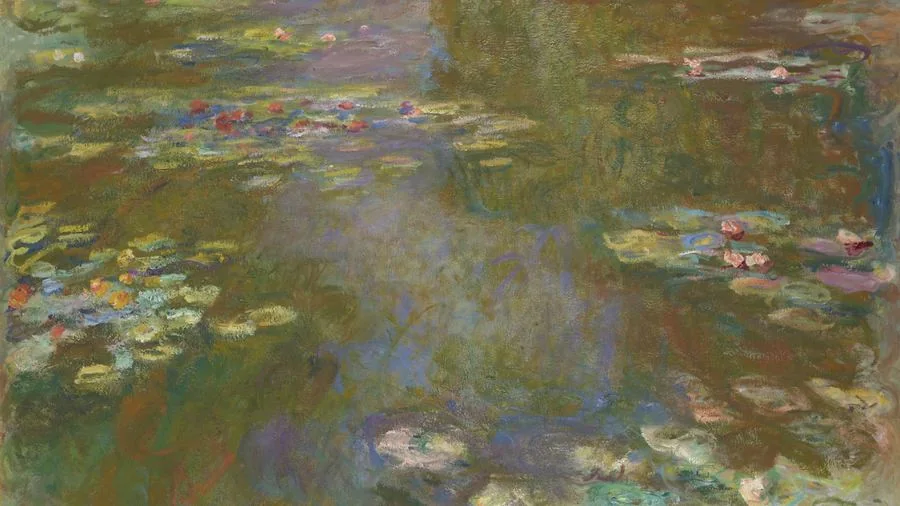
Water lilies on the surface of the pond at Giverny, with the sky and the willows reflected around them and no bank in sight. Claude Monet painted this canvas between 1917 and 1919, during the First World War, as one of nineteen smaller pictures made alongside the monumental water lily panels he would give to France.
Claude Monet · 1917–19 · Oil on canvas · Impressionism · story written 25 September 2026
What you are looking at
There is no horizon. The Art Institute of Chicago, which owns the painting, describes the moment: "During World War I, after several years of inactivity because of bad health and grief over the death of his second wife, Claude Monet embarked on a period of intense work. Building a large studio and improving his garden, he began a group of monumental paintings of water lilies that he would later offer to the French state. Alongside this project, he painted a suite of 19 smaller canvases, including the present one." Smaller is relative: this one is over two metres wide.
How it was painted
Monet had made the pond himself. He moved to Giverny in 1883 and spent the last three decades of his life painting the garden he designed there, some 250 canvases of the water lilies between 1897 and 1926. The Art Institute notes that photographs show him working in the garden, so these paintings were "conceived outdoors and then reworked in his studio", but adds that "by this last stage of his career, the distinction between observation and memory in his work is intangible, and perhaps even irrelevant". The great panels went to the Orangerie in Paris, where they opened in May 1927, a few months after his death.
Where it went
The canvas stayed with Monet and passed to his son Michel at Giverny. It was with the dealer Paul Rosenberg in New York by October 1956, when it was sold to Harvey Kaplan of Chicago, and it came to the Art Institute as a gift of Mrs. Harvey Kaplan. It hangs in Gallery 243.
Why it is in Mura
This is the painting Mura was built for. It has no edges, no subject except light on water, and it was made to be lived with. On a television it does what it did in the studio: it fills the field of vision and stays.
Sources
- Art Institute of Chicago: Water Lily Pond, object record · read 24 September 2026
- Wikipedia: Water Lilies (Monet series) · read 24 September 2026
- Wikipedia: Claude Monet · read 24 September 2026
- Image record (Art Institute of Chicago) · Public domain / CC0
Mura is an art app for Apple TV and iPhone: museum masterworks by Monet, van Gogh, Hokusai, Turner and Renoir, shown one at a time, each with a story to listen to.
Get Mura for Apple TV