MURA · THE COLLECTION · CLAUDE MONET
Water Lilies (Agapanthus)
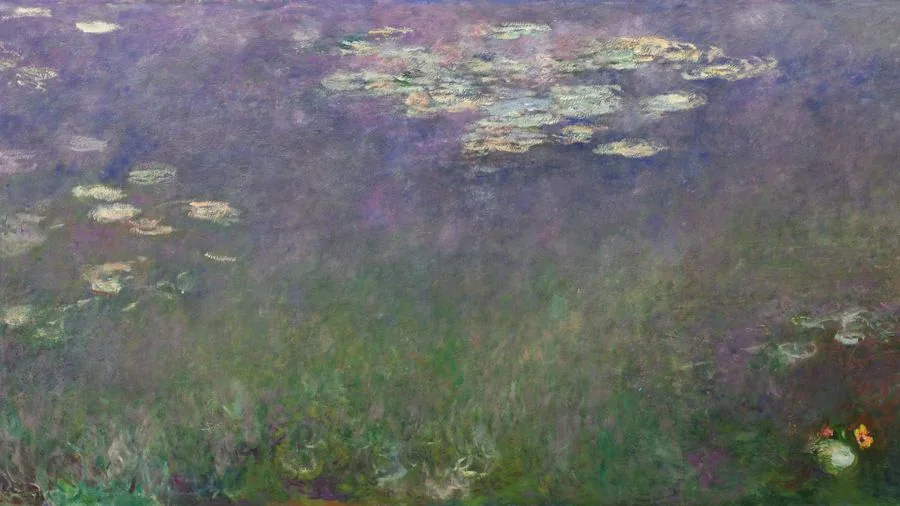
A water lily pond more than four metres wide, with no bank, no horizon and no edge: only the surface, the reflections and the flowers. Claude Monet painted it at Giverny between about 1915 and 1926, and it is one panel of a triptych now divided between Cleveland, Saint Louis and Kansas City.
Claude Monet · c. 1915–26 · Oil on canvas · France, late 19th century-early 20th century · story written 25 September 2026
What you are looking at
The Cleveland Museum of Art, which owns this panel, writes: "Monumental in scale, this rendering of his water lily pond focuses on the momentary effects of sunlight as it both penetrates and reflects off its shimmering surface. By zeroing in on the water and omitting its horizon and surrounding banks, Monet infers a limitless expanse, a perception amplified by the painting's vast horizontal format that fills the viewer's field of vision." The canvas is 201 by 426 centimetres.
How it was painted
Monet was, the museum notes, "a skilled horticulturalist as well as an artist", and he "spent the last 30 years of his life painting the private garden he designed and helped cultivate at his home in Giverny". The water lily paintings run to roughly 250 canvases between 1897 and 1926. This panel belongs to the last, largest phase, when he worked on the great decorations that France installed in two oval rooms at the Orangerie, opened in May 1927, a few months after his death. The Agapanthus triptych stayed outside that gift; its three panels are now in the Cleveland Museum of Art, the Saint Louis Art Museum and the Nelson-Atkins Museum of Art.
Where it went
Cleveland bought its panel in 1960 with the John L. Severance Fund and an anonymous gift, accession number 1960.81. It is on view in Gallery 222.
Why it is in Mura
A painting made to fill the field of vision, shown on the one object in the house built to do the same. Mura shows the whole panel at once; the detail is in the water.
Sources
- Cleveland Museum of Art: Water Lilies (Agapanthus), object record · read 24 September 2026
- Wikipedia: Water Lilies (Monet series) · read 24 September 2026
- Image record (Cleveland Museum of Art) · Public domain / CC0
Mura is an art app for Apple TV and iPhone: museum masterworks by Monet, van Gogh, Hokusai, Turner and Renoir, shown one at a time, each with a story to listen to.
Get Mura for Apple TV