MURA · THE COLLECTION · WINSLOW HOMER
The Water Fan
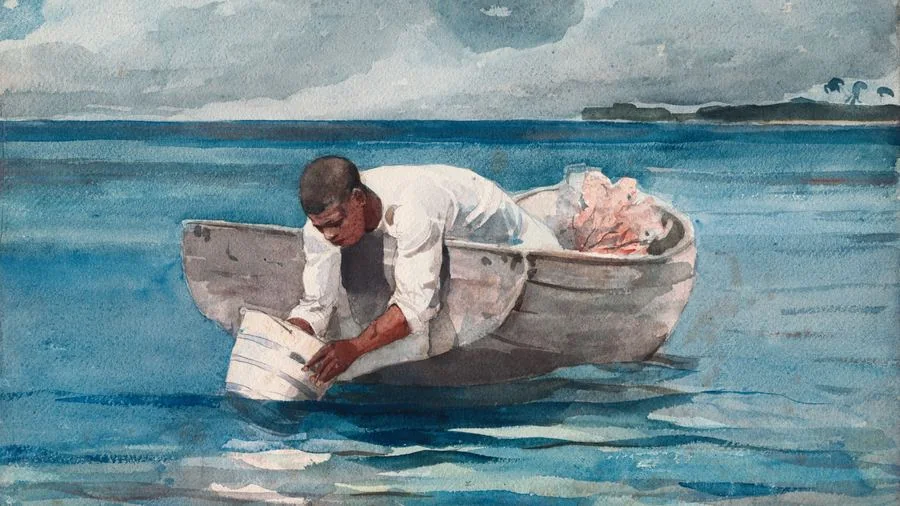
The Water Fan is a watercolour by Winslow Homer, painted in the Bahamas in 1898 or 1899. It shows a young Black man in a small boat searching the sea floor for coral through a glass-bottomed bucket. The sheet measures 37.4 by 53.4 cm and belongs to the Art Institute of Chicago.
Winslow Homer · 1898/99 · Watercolor, with blotting and touches of scraping, over graphite, on thick, rough twill-textured, ivory wove paper · Realism · story written 25 September 2026
What you are looking at
The museum describes a young Black man intently searching for coral with a glass-bottomed bucket. Known as a water glass or sponge glass, the device steadied the moving surface of the water so that he could see below it. Homer may have been drawn to the subject because it points to two things that fascinated him in the Bahamas: the constantly moving surface of the sea and its transparency. The work originally had more visible red washes in the water, hinting at pink coral beneath; those have faded, but fluid strokes of darker blue over layers of transparent turquoise still suggest light playing over water.
How it was painted
Homer was born in Boston in 1836 and began as a commercial illustrator. He took up watercolour in earnest in 1873 during a summer at Gloucester, Massachusetts, and had visited the Bahamas in the winter of 1884–85; by 1900 his watercolours were being painted mostly on trips to Canada and the Caribbean. For The Water Fan he chose a paper with a heavy twill texture. The diagonal pattern, running from top right to lower left, was pressed into the sheet during manufacture by the papermaker's woven wire screen; a truncated watermark reading J WHAT, for the maker J Whatman, reads correctly from the textured side, showing that side was intended for painting. The museum records the technique as watercolour with blotting and touches of scraping over graphite. Homer died in 1910.
Where it went
Homer sold the watercolour in 1907 to James W. Young of Chicago, whose gallery showed it in January 1908 in Ten Watercolors by Winslow Homer and sold it to William and Mary Holabird around that time. It passed to their son John A. Holabird and then to his wife Dorothy, and in 1972 the family gave it to the Art Institute in memory of William and Mary Holabird. It has been lent to the Whitney Museum's Homer retrospective in 1973 and to American Watercolor in the Age of Homer and Sargent in Philadelphia in 2017, and was included in the Art Institute's own Watercolors by Winslow Homer: The Color of Light in 2008. The museum lists no current gallery for it.
Why it is in Mura
It belongs to Mura's Impressionist Life collection with a serene mood: a boat resting on clear turquoise water.
Sources
- Art Institute of Chicago: The Water Fan, object record · read 24 September 2026
- Wikipedia: Winslow Homer · read 24 September 2026
- Image record (Art Institute of Chicago) · Public domain / CC0
Mura is an art app for Apple TV and iPhone: museum masterworks by Monet, van Gogh, Hokusai, Turner and Renoir, shown one at a time, each with a story to listen to.
Get Mura for Apple TV