MURA · THE COLLECTION · VINCENT VAN GOGH
The Plain of Auvers
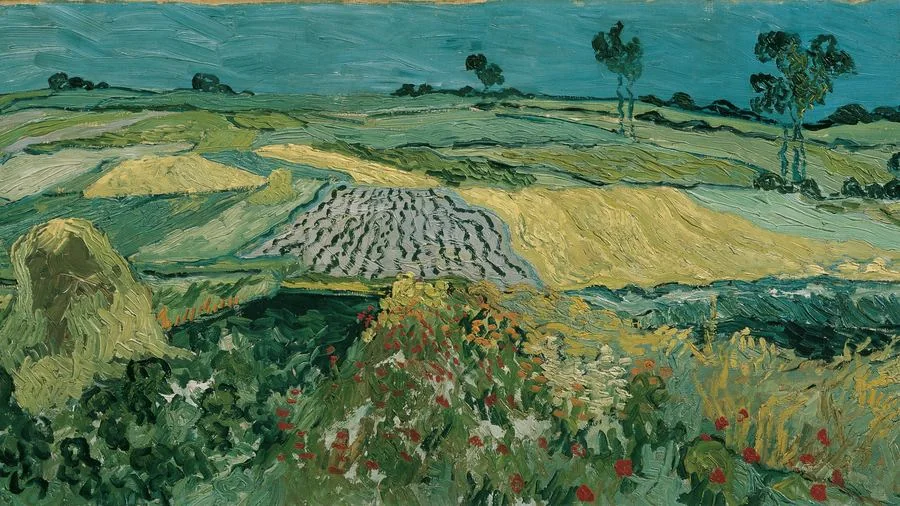
The Plain of Auvers is an oil painting by Vincent van Gogh from the summer of 1890, made at Auvers-sur-Oise in the last two months of his life. It measures 50 by 101 centimetres and belongs to the Österreichische Galerie Belvedere in Vienna, inventory number 1007, where it hangs in the Upper Belvedere.
Vincent van Gogh · 1890 · Oil on canvas · Post-Impressionism · story written 25 September 2026
What you are looking at
Long bands of green and gold fields stretch beneath a blue sky, with tiny red flowers in the foreground. The Belvedere describes a landscape after rain, under "a narrow strip of greeny-blue sky", with red and orange flowers blooming in the foreground and the colours gradually merging into a uniform array of hues towards the horizon. The museum points to the turbulent brushwork and the high horizon as the means by which the expanse of the countryside is conveyed. The painting is unsigned. It is catalogued as F775 and JH2038 and is also known as Wheat Fields near Auvers.
How it was painted
Van Gogh arrived in Auvers in May 1890 after leaving the hospital at Saint-Rémy, and was looked after by Dr Paul Gachet. The Belvedere notes that he entered what it calls a creative frenzy in these final weeks, after his brother Theo sent painting supplies. The Commons record dates the canvas to June or July 1890 and places it among the thirteen works of this elongated format he produced between 17 June and 27 July.
Wikipedia's account of the Auvers wheatfields records that Van Gogh described the plain as vast wheat fields seen after rain, forming a patchwork of yellows, blues and greens. He shot himself on 27 July 1890 and died on 29 July.
Where it went
The Belvedere's provenance runs from the Galerie d'Art C. M. van Gogh in Amsterdam to Johanna van Gogh-Bonger, Theo's widow, who managed the estate. The painting came to Vienna through the Secession, where it was shown in 1903, and the museum's record places its entry into the collection via the Secession in 1909. It is displayed in the Upper Belvedere. The reproduction comes from the Google Cultural Institute file on Wikimedia Commons.
Why it is in Mura
It belongs to the Van Gogh collection with a vibrant mood: the widest and flattest of his Auvers fields, a horizon that suits a television screen.
Sources
- Wikimedia Commons: File:The Plain of Auvers - Vincent van Gogh - Google Cultural Institute.jpg · read 24 September 2026
- Belvedere, Sammlung Online: Vincent van Gogh, Die Ebene von Auvers (The Plain of Auvers) · read 24 September 2026
- Wikipedia: Wheat Fields (Van Gogh series) · read 24 September 2026
- Wikipedia: Vincent van Gogh · read 24 September 2026
- Image record (Wikimedia Commons) · Public domain

Mura is an art app for Apple TV and iPhone: museum masterworks by Monet, van Gogh, Hokusai, Turner and Renoir, shown one at a time, each with a story to listen to.
Get Mura for Apple TV