MURA · THE COLLECTION · CLAUDE MONET
The Petite Creuse River
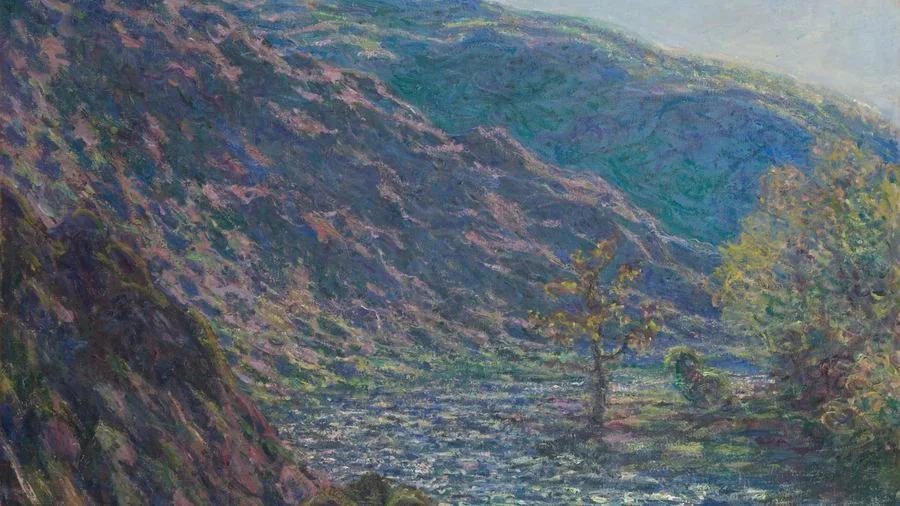
The Petite Creuse runs between bare rocks in the centre of France, with a single oak on the bank. Claude Monet began the canvas in April 1889, came back to it weeks later to find the oak in leaf, and hired workers to strip the tree so that he could finish the painting he had started.
Claude Monet · 1889 · Oil on canvas · Impressionism · story written 25 September 2026
What you are looking at
A narrow river in a steep valley, the water dark and fast, the rocks lit from the side and the oak standing against them without leaves. The Art Institute of Chicago, which owns the painting, tells the story plainly: Monet "began this canvas, one of three of the Petite Creuse, in April 1889 but only returned to it later that spring, by which time the landscape had changed considerably. The oak tree, for example, was sprouting leaves, obscuring the view he had already established. Rather than rework or restart the canvas to depict the current season, Monet hired workers to defoliate the tree so that he could re-create its earlier appearance."
How it was painted
Monet had visited the Creuse valley for a few days in February 1889 with the critic Gustave Geffroy and returned in early March for three months. The museum writes that "despite bouts of poor health and bad weather, he returned to Giverny having painted 24 canvases", and that these "constituted the artist's first planned and rigorously defined series of paintings", a year before the stacks of wheat.
Where it went
The painting was bought by Potter Palmer of Chicago, or possibly by his wife Bertha, and passed by descent to the family, who gave it to the Art Institute in 1922. It hangs in Gallery 240 as part of the Potter Palmer Collection.
Why it is in Mura
The stripped oak is the most honest fact in the collection: Monet wanted the picture he had begun, not the season he found. Mura shows the valley alone and leaves the tree bare.
Sources
- Art Institute of Chicago: The Petite Creuse River, object record · read 24 September 2026
- Wikipedia: Claude Monet · read 24 September 2026
- Image record (Art Institute of Chicago) · Public domain / CC0
Mura is an art app for Apple TV and iPhone: museum masterworks by Monet, van Gogh, Hokusai, Turner and Renoir, shown one at a time, each with a story to listen to.
Get Mura for Apple TV