MURA · THE COLLECTION · CAMILLE PISSARRO
The Lock at Pontoise
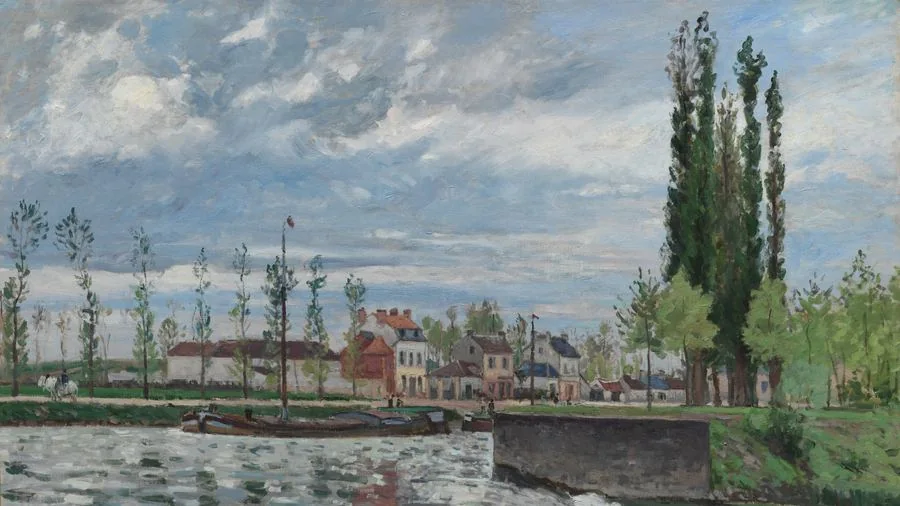
A river lock near Camille Pissarro's home at Pontoise, painted in 1872, the year he settled back there after the Franco-Prussian War. The canvas, 53 by 83 centimetres, was bought by the Cleveland Museum of Art in 1990 with the Leonard C. Hanna Jr. Fund. It is one of the early Impressionist landscapes on which his reputation rests.
Camille Pissarro · 1872 · Oil on fabric · France, 19th century · story written 25 September 2026
What you are looking at
The museum writes: "The rushing water and overcast sky in this view of a river lock near the artist's home at Pontoise, a rural commune about 17 miles northwest of Paris, are rendered with rapid, broken brushstrokes of pure color." Mura's catalogue describes the lock opening towards village rooftops and tall poplars beneath a cloud-filled sky. The museum adds that the river shown here is 341 kilometres long.
How it was painted
Pissarro (1830–1903) was, in the museum's words, "instrumental in developing the radically new Impressionist technique of painting quickly outdoors to capture fleeting effects of light and atmosphere". Of this canvas it says: "Painting directly on canvas without preliminary drawing, Pissarro may have executed this work in a single session. The shimmering surface of broken color conveys the sensation of natural, outdoor light." He had first settled in Pontoise in 1866, and, according to Wikipedia, lived there from 1872 to 1884; from 1872 Cézanne walked out to paint beside him in the surrounding countryside. In 1873 he helped establish the collective society of artists that became the Impressionists, and he was the only one of them to show at all eight of their exhibitions.
Where it went
The earliest secure owner is Charles Guasco; the Wildenstein catalogue raisonné suggests, with question marks, that Durand-Ruel bought the painting from Pissarro in May 1872 and sold it in 1873, but the gallery's archives cannot confirm this. At the Guasco sale at the Galerie Georges Petit on 11 June 1900 it went to Louis Schoengrün, whose own sale at the Hôtel Drouot on 7 February 1901 passed it to Max Behrendt of Paris, who lent it to exhibitions in 1928 and 1931. The Cleveland Museum of Art acquired it in 1990, accession number 1990.7. It has since travelled to "Paul Durand-Ruel and Impressionism" (Paris, London, Philadelphia, 2014–15), to the Musée Marmottan Monet (2017) and to "The Honest Eye" at the Museum Barberini and the Denver Art Museum (2025–26). It is currently not on view.
Why it is in Mura
Part of the Coast & Countryside collection with the mood "fresh": moving water and open sky, painted fast, for a wall that changes slowly.
Sources
- Cleveland Museum of Art: The Lock at Pontoise, object record · read 24 September 2026
- Cleveland Museum of Art Open Access API: The Lock at Pontoise (1990.7) · read 24 September 2026
- Wikipedia: Camille Pissarro · read 24 September 2026
- Image record (Cleveland Museum of Art) · Public domain / CC0
Mura is an art app for Apple TV and iPhone: museum masterworks by Monet, van Gogh, Hokusai, Turner and Renoir, shown one at a time, each with a story to listen to.
Get Mura for Apple TV