MURA · THE COLLECTION · J. M. W. TURNER
The Fighting Temeraire
The Fighting Temeraire is an oil painting by J. M. W. Turner, exhibited in 1839, showing a veteran warship of Trafalgar being towed up the Thames by a steam tug to be broken up. It measures 90.7 by 121.6 centimetres and belongs to the National Gallery in London, inventory number NG524, part of the Turner Bequest of 1856.
J. M. W. Turner · 1839 · Oil on canvas · Romanticism · story written 25 September 2026
What you are looking at
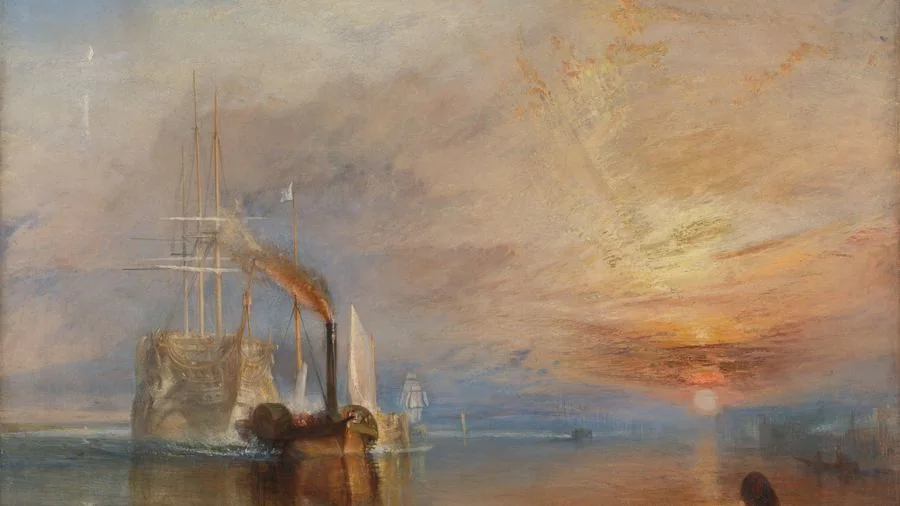
A pale sailing ship meets a glowing sunset on its final journey along the Thames. The full title is The Fighting Temeraire tugged to her last berth to be broken up, 1838. HMS Temeraire was a 98-gun second-rate ship that fought at Trafalgar in 1805; in 1838 she was towed from Sheerness to Rotherhithe for scrapping. The National Gallery describes the ship in ghostly whites and golds, masts intact, set against the small dark tug, with the sunset filling the right of the canvas.
How it was painted
Turner, born in London in 1775, did not record the event literally. The gallery says he worked from contemporary reports and made a poetic picture of the end of the age of sail. Wikipedia lists the liberties: the ship's masts had in fact been removed before the voyage, and the direction of the sunset does not fit the geography of the river. The gallery adds that the placing of the tug's funnel was altered and that the missing Union flag marks the ship's loss of naval status.
At the Royal Academy in 1839 Turner hung the painting with lines adapted from Thomas Campbell: "The flag which braved the battle and the breeze, / No longer owns her." He refused to sell it, and later wrote that "no considerations of money or favour can induce me to lend my Darling again".
Where it went
Turner died in 1851. His will was contested, and the litigation ended in 1856 with the Turner Bequest to the nation, which brought this painting into the National Gallery, where it hangs in Room 40. A BBC Radio 4 poll in 2005 voted it Britain's favourite painting, and in 2020 it appeared on the polymer twenty-pound note. The reproduction is the Commons file taken from the gallery's website.
Why it is in Mura
It belongs to the Coast & Countryside collection with a golden mood: a sunset picture about an ending, painted for the widest possible audience.
What you hear in the app
The smallest vessel here is doing the hardest work. Look at the dark steam tug. It is pulling the great pale ship towards the end of her life.
Turner painted this picture in eighteen thirty-nine, following the Temeraire's final journey to be broken up. The ship had fought at the Battle of Trafalgar. Here, that celebrated past appears almost weightless beside the tug's smoke and effort.
But this is no straightforward record. By the time of the journey, the ship's masts had already been removed. Turner gave them back. He also transformed her dark, practical colouring into something luminous, almost ghostly.
Even the sunset serves the painting rather than the geography. Turner rearranged what a witness would have seen to give the departure its emotional force.
Let your eye move between the old ship, the working tug and the low sun. We might read a farewell in those relationships. Yet steam also supplies the movement that carries the picture forward. The past is magnificent; the future is already at work.
Sources
- Wikimedia Commons: File:Turner, J. M. W. - The Fighting Téméraire tugged to her last Berth to be broken.jpg · read 24 September 2026
- Wikipedia: The Fighting Temeraire · read 24 September 2026
- National Gallery, London: Joseph Mallord William Turner, The Fighting Temeraire · read 24 September 2026
- Wikipedia: J. M. W. Turner · read 24 September 2026
- Image record (Wikimedia Commons) · Public domain

Mura is an art app for Apple TV and iPhone: museum masterworks by Monet, van Gogh, Hokusai, Turner and Renoir, shown one at a time, each with a story to listen to.
Get Mura for Apple TV