MURA · THE COLLECTION · CLAUDE MONET
The Customs House at Varengeville
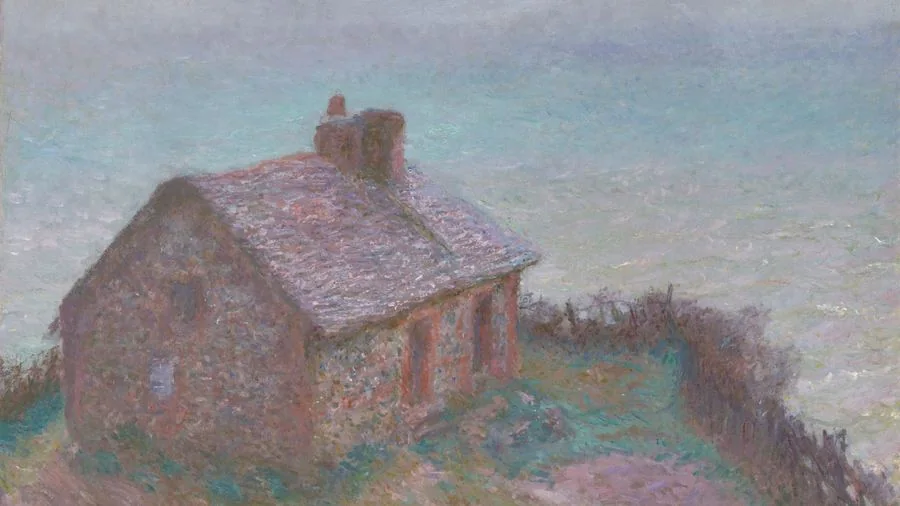
A small stone hut clings to a cliff above the sea at Varengeville on the Normandy coast. Claude Monet painted the customs house eight times, four in 1882 and four more in 1897; this is one of the later four, and the Art Institute of Chicago describes the paint as scraped and wiped to let the colours beneath show through.
Claude Monet · 1897 · Oil on canvas · Impressionism · story written 25 September 2026
What you are looking at
The customs house was a lookout post for coastguards, and Monet chose the same vantage each time, "looking down on the small structure, which appears to grow out of the cliffside". Below it the sea is pale grey, and in that grey the museum points to "breaks in the pale-gray paint" that "reveal a bright green beneath, which the artist accentuated with additional touches of a similar green on top".
How it was painted
In 1897 Monet "increased the amount of white in his paints to capture more nuanced atmospheric effects", the Art Institute writes, and "experimented with techniques to animate the surface, at times scraping down or wiping away the still-soft paint to expose underlying colors". The four canvases from this second visit are almost identical in size. It is a late work in the manner of the series he had begun with the stacks of wheat in 1890: one motif, returned to until the weather and the hour became the subject.
Where it went
Monet's own account book records the sale to the Galerie Allard et Noël in February 1899 for 6,000 francs. The painting belonged to the Paris collector Maurice Masson by 1911, when it was sold at the Hôtel Drouot to Durand-Ruel for 9,020 francs under the title La cabane du douanier. It was shown in Chicago at the Stratford Hotel in 1914 and came to the Art Institute in the Mr. and Mrs. Martin A. Ryerson Collection.
Why it is in Mura
It is the quietest Monet in the collection: one hut, one cliff, one sea. On a screen the green under the grey is the thing to look for, and it takes a while to appear.
Sources
- Art Institute of Chicago: The Customs House at Varengeville, object record · read 24 September 2026
- Image record (Art Institute of Chicago) · Public domain / CC0
Mura is an art app for Apple TV and iPhone: museum masterworks by Monet, van Gogh, Hokusai, Turner and Renoir, shown one at a time, each with a story to listen to.
Get Mura for Apple TV