MURA · THE COLLECTION · CLAUDE MONET
Stacks of Wheat (End of Summer)
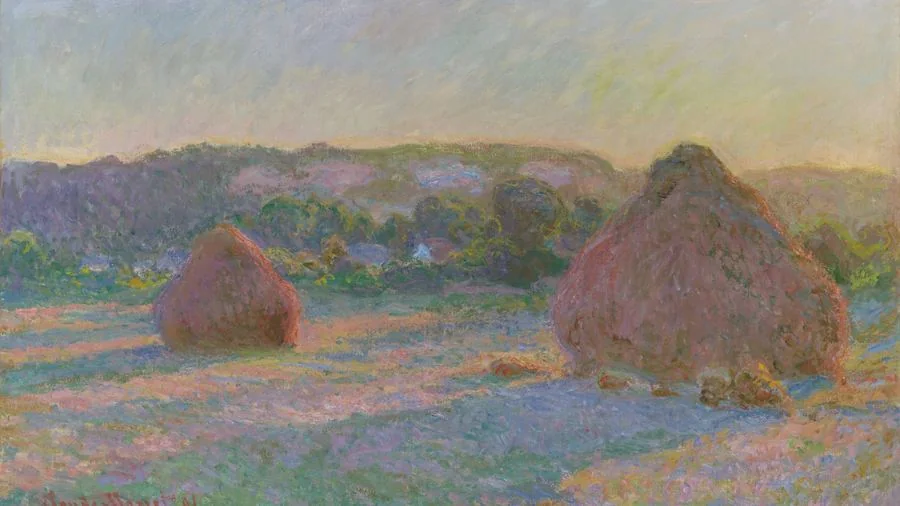
A stack of wheat, fifteen to twenty feet tall, stands in a field at the end of summer with the light still warm on its flank. Claude Monet painted it in 1890 and 1891 just outside his farmhouse at Giverny, as one of a series of twenty-five canvases of the same stacks in changing light and weather.
Claude Monet · 1890–91 · Oil on canvas · Impressionism · story written 25 September 2026
What you are looking at
The stack is not hay. The sheaves stored grain for bread, wheat most likely, and Monet's neighbour, the farmer Quéruel, built them in the field beside the artist's house after the harvest of 1890. The Art Institute of Chicago, which owns this canvas, describes stacks that "rose fifteen to twenty feet" and notes that in the autumn views "the conical tops of the stacks break the horizon and push into the sky", where the winter views wrap the stacks in bands of hill and field "as if bedded down for the season". This is one of the late-summer views: the top of the stack cuts into a sky that is still bright, and the field behind it holds the last of the season's colour.
How it was painted
Monet worked on the series both outdoors, "painting simultaneously at several easels", and in the studio, where he refined the harmonies between canvases. The point was never a single stack but the same stack seen again and again: at different hours, in frost, in fog, at sunset. In May 1891 he hung fifteen of the canvases together in one small room at the Galerie Durand-Ruel in Paris. The museum calls the show "an unprecedented critical and financial success" and "a breakthrough in Monet's career, as well as in the history of French art". Most of the paintings sold within a month, at around a thousand francs each.
Where it went
The Durand-Ruel stock books record this canvas leaving Monet on 9 May 1891 for 3,000 francs, sold on to a Boston collector in June for 5,000 and taken back in exchange for another Monet in August. It later belonged to Bertha Palmer of Chicago, who lent it to Boston in 1905, and it came to the Art Institute as a gift of Arthur M. Wood in memory of Pauline Palmer Wood. The museum now holds the largest group of Monet's Stacks of Wheat anywhere, six of the twenty-five, and hangs this one in Gallery 243.
Why it is in Mura
The stacks are the clearest case of what Monet was after: not a thing but the light on a thing. On a television that is a rare gift, because the canvas was made to be looked at slowly while the light changed. Mura shows it alone and lets it stay.
Sources
- Art Institute of Chicago: Stacks of Wheat (End of Summer), object record · read 24 September 2026
- Wikipedia: Haystacks (Monet series) · read 24 September 2026
- Image record (Art Institute of Chicago) · Public domain / CC0
Mura is an art app for Apple TV and iPhone: museum masterworks by Monet, van Gogh, Hokusai, Turner and Renoir, shown one at a time, each with a story to listen to.
Get Mura for Apple TV