MURA · THE COLLECTION · CLAUDE MONET
Stacks of Wheat (End of Day, Autumn)
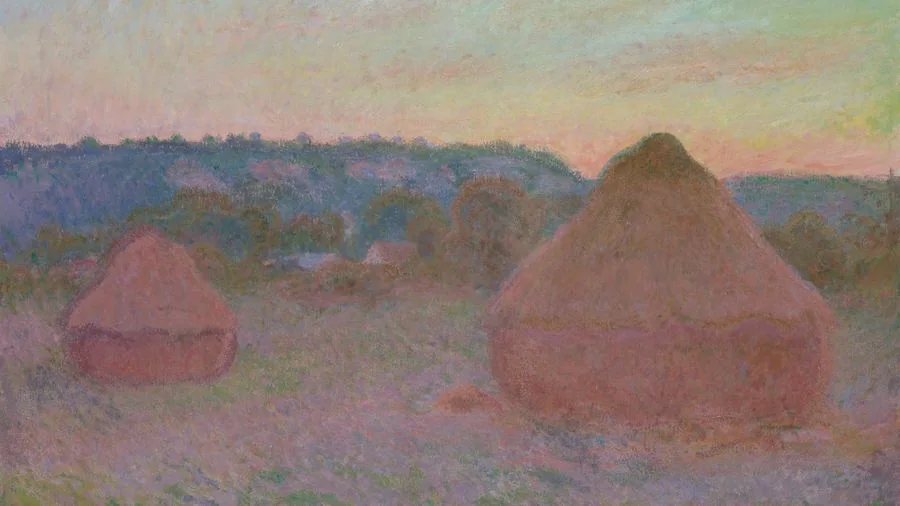
Two stacks of wheat stand in an autumn field at the end of the day, their shadows long and their tops pushed up against a cooling sky. Claude Monet painted the pair in 1890 and 1891 beside his house at Giverny, part of the series of twenty-five stacks that made his name and his fortune in a single exhibition.
Claude Monet · 1890–91 · Oil on canvas · Impressionism · story written 25 September 2026
What you are looking at
The stacks belonged to the neighbouring farmer and stored sheaves of grain for bread rather than hay for animals. The Art Institute of Chicago, which owns this painting, notes that in "nearly all of the autumn views in the series, the conical tops of the stacks break the horizon and push into the sky", and that is what happens here: the two cones rise past the line of hills and hold the last light while the field beneath them goes into shadow. For Monet, the museum writes, the stack was "a resonant symbol of sustenance and survival".
How it was painted
Through 1890 and 1891 Monet worked at several easels at once in the field, moving from canvas to canvas as the light moved, and then refined the group in the studio. The Art Institute describes the method as painting "both in the field, painting simultaneously at several easels, and in the studio, refining pictorial harmonies". In May 1891 fifteen of the canvases hung together in one room at the Galerie Durand-Ruel in Paris, a show the museum calls a breakthrough "in the history of French art". He went on to paint poplars, the facade of Rouen Cathedral and, at the end, his own garden, in the same way.
Where it went
Durand-Ruel bought this canvas from Monet on 2 July 1891 for 3,200 francs and, the stock books say, sold it the same day through the New York branch to Potter Palmer of Chicago for 1,200 dollars. It has stayed in Chicago since, entering the Art Institute through the Mr. and Mrs. Lewis Larned Coburn Memorial Collection, and hangs in Gallery 243 with the museum's other stacks, the largest group in the world.
Why it is in Mura
End of day, autumn: the title is the whole idea. Mura shows the canvas alone on the screen, and the longer it stays, the more the shadow on the near stack reads as an hour rather than a colour.
Sources
- Art Institute of Chicago: Stacks of Wheat (End of Day, Autumn), object record · read 24 September 2026
- Wikipedia: Haystacks (Monet series) · read 24 September 2026
- Image record (Art Institute of Chicago) · Public domain / CC0
Mura is an art app for Apple TV and iPhone: museum masterworks by Monet, van Gogh, Hokusai, Turner and Renoir, shown one at a time, each with a story to listen to.
Get Mura for Apple TV