MURA · THE COLLECTION · CLAUDE MONET
Poppy Field (Giverny)
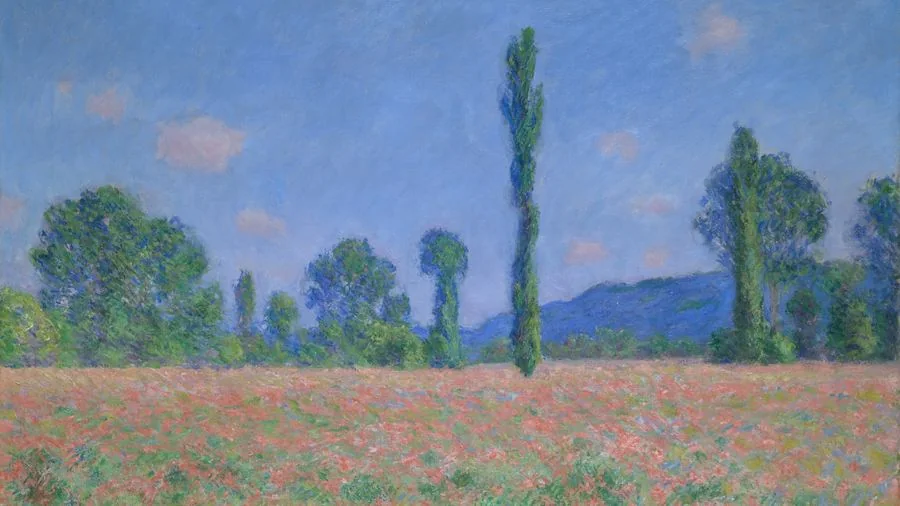
A field of poppies near Giverny, painted in the summer of 1890 as one of four canvases of almost the same size. Claude Monet began them in July, weeks before the stacks of wheat that would become his first great series, and they show him learning to work on several paintings of one motif at once.
Claude Monet · 1890–91 · Oil on canvas · Impressionism · story written 25 September 2026
What you are looking at
Red poppies scattered through a green field, with the land rising to a line of trees and a strip of sky. The Art Institute of Chicago, which owns the painting, points out that these four poppy fields "demonstrate a far more homogeneous touch than the freely brushed landscapes of his earlier career, with surfaces that have a tapestry-like materiality". The brushstrokes are small, even and dense, so that the field reads as a woven surface rather than as separate marks.
How it was painted
The museum's record is precise: "In July 1890, Claude Monet began four almost identically scaled canvases showing poppy fields near his home in Giverny." He did not think of them as a series in the way he would think of the twenty-five stacks he started "shortly after the harvest that same summer", but they show, in the museum's words, "his growing interest in developing several canvases at once". Monet had moved to Giverny in 1883, and by 1890 the fields around the house were his daily subject.
Where it went
The painting was probably sold in Paris in September 1891 through an agent for the New York dealer Knoedler, and by January 1893 it belonged to Potter Palmer of Chicago, on deposit with Durand-Ruel in New York under the title Coquelicots. It was shown in New York in 1893 and 1895 and came to the Art Institute in the Mr. and Mrs. W. W. Kimball Collection. It hangs in Gallery 240.
Why it is in Mura
There is an earlier, more famous poppy field by Monet, painted at Argenteuil in 1873 and also in Mura. Seen together they show what seventeen years did to his hand: the same red in the same green, but the later one is a surface you could touch.
Sources
- Art Institute of Chicago: Poppy Field (Giverny), object record · read 24 September 2026
- Wikipedia: Claude Monet · read 24 September 2026
- Image record (Art Institute of Chicago) · Public domain / CC0
Mura is an art app for Apple TV and iPhone: museum masterworks by Monet, van Gogh, Hokusai, Turner and Renoir, shown one at a time, each with a story to listen to.
Get Mura for Apple TV