MURA · THE COLLECTION · CLAUDE MONET
Poppy Field
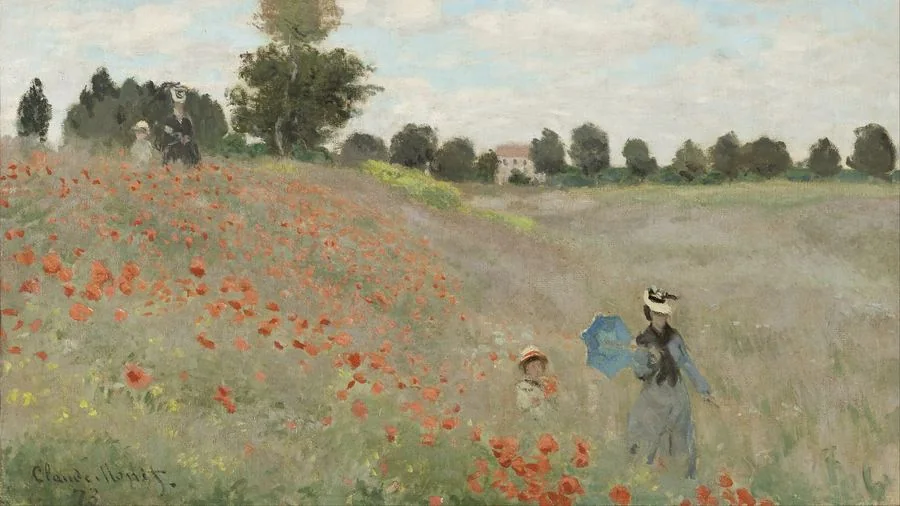
A woman and a child walk down through a field of poppies under a summer sky, and a second pair stands on the ridge above them. Claude Monet painted it at Argenteuil in 1873, and it is one of the pictures most people mean when they say the word Impressionism.
Claude Monet · 1873 · Oil on canvas · Impressionism · story written 25 September 2026
What you are looking at
The poppies are dabs of red that grow larger as they come towards you, until the nearest are simply patches of paint with no attempt at a flower. Two figures with parasols come down the slope, and two more, small, stand at the top under the tree line. The painting is in the Musée d'Orsay in Paris, accession number RF 1676; the record on Wikimedia Commons gives its French title, Coquelicots, and its size, 50 by 65 centimetres, oil on canvas, dated 1873.
How it was painted
Monet had settled in Argenteuil, a small town on the Seine outside Paris, in 1871, and the fields around it were his subject as much as the river. The following year, 1874, he took part in the first independent exhibition of the painters who would be called Impressionists, the show at which the critic Louis Leroy borrowed the title of Monet's Impression, Sunrise to mock the whole group. The poppy field belongs to that moment: painted fast, outdoors, with the figures as unfinished as the flowers.
Where it went
The painting hangs at the Musée d'Orsay, the museum that holds the French state's Impressionist collection. The reproduction in Mura comes from the Google Art Project scan of the canvas, published on Wikimedia Commons in the public domain.
Why it is in Mura
Mura hangs this beside the poppy field Monet painted at Giverny in 1890, and the pair is the shortest lesson in the collection: the same flowers, seventeen years apart, first as a walk and then as a surface.
Sources
- Wikimedia Commons: Claude Monet, Poppy Field, Google Art Project record · read 24 September 2026
- Wikipedia: Claude Monet · read 24 September 2026
- Image record (Wikimedia Commons) · Public domain

Mura is an art app for Apple TV and iPhone: museum masterworks by Monet, van Gogh, Hokusai, Turner and Renoir, shown one at a time, each with a story to listen to.
Get Mura for Apple TV