MURA · THE COLLECTION · VASILY KANDINSKY
Painting with Troika
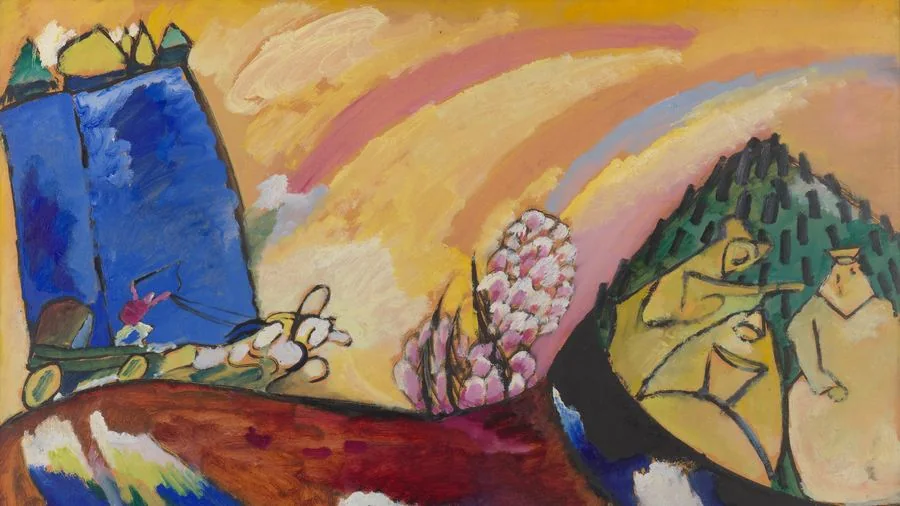
Painting with Troika is an oil painting on cardboard by Vasily Kandinsky, dated 18 January 1911 and set in a frame he painted himself. A troika, the traditional Russian carriage drawn by three horses, crosses a coloured landscape. It measures 69.7 by 97.3 cm and hangs in Gallery 392 of the Art Institute of Chicago.
Vasily Kandinsky · January 18, 1911 · Oil on cardboard; in artist's painted frame · story written 25 September 2026
What you are looking at
The catalogue entry describes a troika moving through sweeping fields of blue, gold and pink towards a distant village. The museum points to two things: the troika itself, and the hand-painted frame Kandinsky made especially for this work. Both, it says, speak to the influence of folk and non-Western sources on his art.
How it was painted
Kandinsky was born in Moscow in 1866. In 1889 he joined an ethnographic expedition to the Vologda region north of Moscow, where the painted houses and churches made him feel he was walking into a picture; the bright colours on dark grounds of that folk art stayed with him. He gave up a career in law to study painting in Munich in 1896 and from 1908 worked often in the Bavarian town of Murnau. The museum describes him as a founding member, with Franz Marc, Gabriele Münter and Alexei Jawlensky, of Der Blaue Reiter, the Blue Rider, a loose alliance of Munich artists who shared a belief in the symbolic and spiritual importance of form and colour and looked to non-Western, medieval and folk art. The group took shape in December 1911, months after this painting; its almanac appeared in May 1912. Painting with Troika was shown in Zurich and Frankfurt in 1912 and reproduced in the 1913 volume Kandinsky 1901–1913, published by Der Sturm in Berlin. Kandinsky died at Neuilly-sur-Seine in 1944.
Where it went
The painting was bought by Arthur Jerome Eddy, a Chicago lawyer and one of the first American collectors of modern art. Eddy bought heavily at the Armory Show of 1913, and his book Cubists and Post-Impressionism of 1914 gave the first adequate account of Kandinsky in America; by his death in 1920 he owned four of the artist's paintings. The Art Institute showed his collection in 1922, and in 1931 his widow Lucy and son Jerome gave twenty paintings and three sculptures to the museum as the Arthur Jerome Eddy Memorial Collection, this one among them. It has since been lent to a Kandinsky memorial exhibition in Chicago in 1945 and to the Lenbachhaus in Munich in 1995.
Why it is in Mura
It belongs to Mura's Modern Colour collection with a vibrant mood: three horses through fields of blue, gold and pink.
What you hear in the app
Before trying to name everything, notice where the colour takes you. A bright patch calls across the picture; a dark shape holds it back. Your eye is already moving before the scene becomes clear.
Kandinsky painted this work in nineteen eleven. Its title offers one foothold: a troika is a carriage drawn by three horses. Look towards the lower left, where the pale horses gather into a lively group.
Around them, buildings and landscape remain recognisable, but they are not organised like a carefully measured view. Colour has a freedom of its own.
Kandinsky and the artists associated with the Blue Rider were interested in the emotional and spiritual possibilities of colour and form. Folk art was one of their important sources of inspiration. That helps explain why simplification here is a choice, rather than a lack of observation.
You can recognise a journey without agreeing on every detail. Let the horses give you an entry into the picture, then let the colours lead. The scene becomes less like a place to map, and more like an experience to move through.
Sources
- Art Institute of Chicago: Painting with Troika, object record · read 24 September 2026
- Wikipedia: Wassily Kandinsky · read 24 September 2026
- Wikipedia: Der Blaue Reiter · read 24 September 2026
- Wikipedia: Arthur Jerome Eddy · read 24 September 2026
- Image record (Art Institute of Chicago) · Public domain / CC0
Mura is an art app for Apple TV and iPhone: museum masterworks by Monet, van Gogh, Hokusai, Turner and Renoir, shown one at a time, each with a story to listen to.
Get Mura for Apple TV