MURA · THE COLLECTION · JEAN BAPTISTE CAMILLE COROT
Monte Pincio, Rome
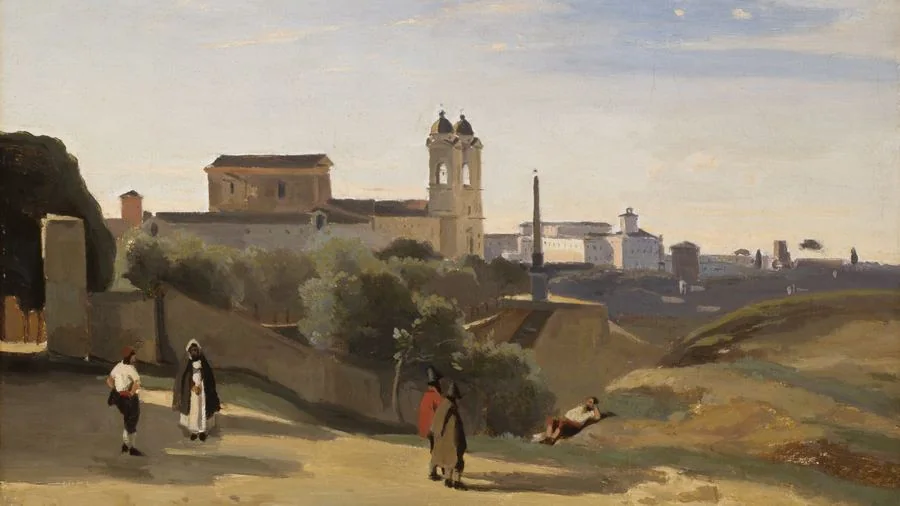
Monte Pincio, Rome is a small oil painting by Jean-Baptiste-Camille Corot, dated by the Art Institute of Chicago to 1840–50. It shows the Pincian Hill in Rome and measures 27 by 40.6 cm. The museum bought it in 1942 for the Mr. and Mrs. Lewis Larned Coburn Memorial Collection, and it hangs in Gallery 221.
Jean Baptiste Camille Corot · 1840–50 · Oil on canvas · 19th century · story written 25 September 2026
What you are looking at
The catalogue entry describes warm stone buildings rising above a sunlit Roman path and a few unhurried walkers. The Pincian Hill lies in the north-east of the historic centre of Rome, above the Campus Martius; it was known in antiquity as the Hill of Gardens. The gardens seen today were laid out in 1809–14 by Giuseppe Valadier, with wide gravelled avenues and an obelisk set up in 1822, and the French Academy has occupied the Villa Medici on the hill since 1802. When the picture was shown in Paris in 1936 it was catalogued as Rome, La Trinité des Monts.
How it was painted
Corot was born in Paris in 1796 and first went to Italy in 1825, staying until 1828 and returning twice more. He was a major proponent of painting studies outdoors, but essentially a studio painter who finished few landscapes in front of the motif; he collected sketches on his summer travels and worked from them, and from memory, in the winter. That is why the museum gives a range of years rather than a single date for this canvas. After his fiftieth year his handling broadened, with thicker paint and an emphasis on breadth of tone. He died in Paris in 1875.
Where it went
The back of the canvas carries the stamp of the Paris dealer C. Tempelaere. By 1925 the painting belonged to Henry Marcel in Paris, who lent it to Le Paysage Français de Poussin à Corot at the Petit Palais; after his death in 1926 it passed to his widow, who lent it to the Corot exhibition at the Orangerie in 1936. André Weil of the Matignon Art Galleries in New York had it by 1942 and sold it to the Art Institute that December. John Rewald illustrated it in Art News in November 1942 in an article on Corot's sources. It travelled to the Corot retrospective in Paris, Ottawa and New York in 1996–97.
Why it is in Mura
It belongs to Mura's Impressionist Life collection with a golden mood: Roman stone in afternoon sun.
Sources
- Art Institute of Chicago: Monte Pincio, Rome, object record · read 24 September 2026
- Wikipedia: Jean-Baptiste-Camille Corot · read 24 September 2026
- Wikipedia: Pincian Hill · read 24 September 2026
- Image record (Art Institute of Chicago) · Public domain / CC0
Mura is an art app for Apple TV and iPhone: museum masterworks by Monet, van Gogh, Hokusai, Turner and Renoir, shown one at a time, each with a story to listen to.
Get Mura for Apple TV