MURA · THE COLLECTION · VINCENT VAN GOGH
Landscape at Twilight
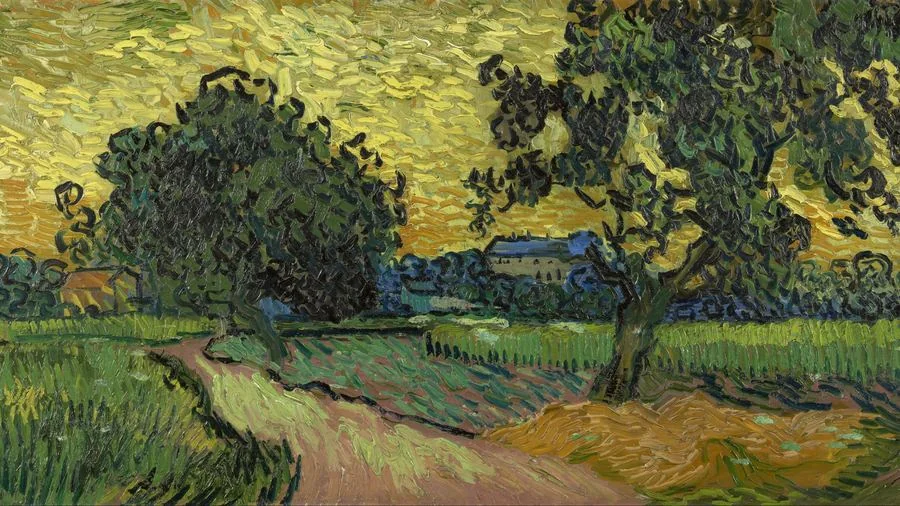
Landscape at Twilight is an oil painting by Vincent van Gogh from June 1890, made in the fields around Auvers-sur-Oise. It is about 50 centimetres high and a metre wide and belongs to the Van Gogh Museum in Amsterdam (Vincent van Gogh Foundation), object number s0107V1962, catalogued as F770 and JH2040.
Vincent van Gogh · 1890 · Oil on canvas · Post-Impressionism · story written 25 September 2026
What you are looking at
A yellow evening sky glows behind dark trees, while a path bends through the green fields. The Van Gogh Museum says the view takes in the local castle, and that the tangled black branches of the pear trees were rendered "with a flurry of black brushstrokes", which sharpens the contrast between the dark trees and the luminous sky. The museum also observes that the wide format makes the picture feel like a panorama.
How it was painted
Van Gogh moved to Auvers in May 1890, after a year in the hospital at Saint-Rémy, and was cared for by Dr Paul Gachet. Starting in June he cut a series of canvases from a large roll, each one metre wide and 50 centimetres high; the museum counts thirteen works in this size, all but one of them landscapes. This is one of the earliest of them. The museum measures it at 50.2 by 101 centimetres; the Commons record gives 50 by 107. He died in Auvers on 29 July 1890, two days after shooting himself.
Where it went
According to the museum's provenance, the canvas went to Theo van Gogh in Paris in the second half of June 1890. After Theo's death in January 1891 it passed to his widow, Jo van Gogh-Bonger, and their son, Vincent Willem van Gogh. Jo lent it to the Rijksmuseum from 1917 to 1919 and her son did the same from 1927 to 1930; from 22 October 1931 it was on loan to the Stedelijk Museum in Amsterdam. Vincent Willem gave it to the first Vincent van Gogh Foundation on 11 March 1952, and after transfers through the Theo van Gogh Foundation it came to the present Vincent van Gogh Foundation on 21 July 1962, the day the foundation and the Dutch state agreed to build a museum for the collection. It has been at the museum since it opened on 2 June 1973 and is shown in the Auvers-sur-Oise room. The reproduction is the Google Art Project file on Wikimedia Commons.
Why it is in Mura
It sits in the Van Gogh collection with a golden mood: a quiet evening picture from the same summer as the wheatfields, without their tension.
What you hear in the app
Before looking at the sunset, consider the shape of this painting. Its long, narrow canvas was a deliberate experiment.
Van Gogh painted Landscape at Twilight near Auvers-sur-Oise in June eighteen ninety. The original is about a metre wide and half a metre high. Beginning that June, he made thirteen paintings in this unusually broad format. Twelve were landscapes; one was a portrait. According to the Van Gogh Museum, he cut the canvases himself from a large roll.
That makes this more than an isolated evening view. It belongs to a sustained exploration of how much landscape a painting can hold.
The place is specific, too. The museum identifies pear trees in the foreground and a view towards the local castle. Their dark, tangled branches stand against the luminous yellow sky. The contrast gives the trees their force even as the daylight fades.
The Thyssen museum places this work within a wider group that also includes gardens, cottages and woodland. Van Gogh was exploring different aspects of rural life through a shared format.
Knowing that changes the encounter: behind the immediate drama of the evening is an artist making deliberate choices, from the cut of the canvas to the relationship between trees, sky and distance.
Sources
- Wikimedia Commons: File:Vincent van Gogh - Landscape at twilight - Google Art Project.jpg · read 24 September 2026
- Van Gogh Museum: Landscape at Twilight (s0107V1962) · read 24 September 2026
- Wikipedia: Vincent van Gogh · read 24 September 2026
- Image record (Wikimedia Commons) · Public domain

Mura is an art app for Apple TV and iPhone: museum masterworks by Monet, van Gogh, Hokusai, Turner and Renoir, shown one at a time, each with a story to listen to.
Get Mura for Apple TV