MURA · THE COLLECTION · CLAUDE MONET
Gardener's House at Antibes
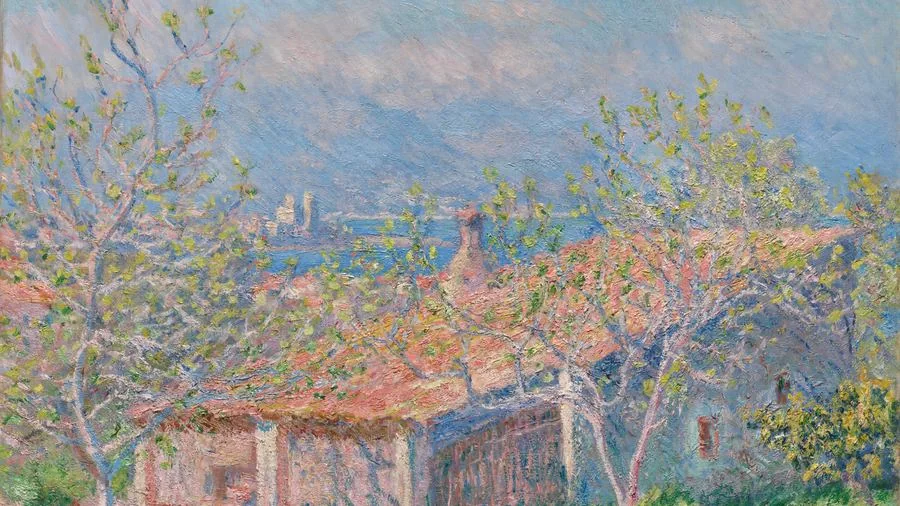
A gardener's house in the midday sun at Antibes, with the Mediterranean behind it and the Alps in the distance. Claude Monet painted it in 1888 during four months on the Riviera, where the wind sometimes threatened to blow his easel over and where he nonetheless finished nearly forty canvases.
Claude Monet · 1888 · Oil on canvas · France, 19th century · story written 25 September 2026
What you are looking at
The Cleveland Museum of Art, which owns the painting, describes "a gardener's house set against the sea and the distant Alps" and says that "Monet portrays intense midday light through thickly applied paint in bright colors that evoke the region's sun-drenched climate. Small daubs of green on the slender trees framing the house suggest the onset of spring." The house is pink and ochre, the sea a flat band of blue, and the mountains float above it in a paler blue that is almost the sky.
How it was painted
Monet arrived in Antibes early in 1888 and stayed four months "to derive inspiration for painting", in the museum's words. The visit "was occasionally challenged by strong winds that threatened to knock over his easel", but he completed nearly forty works. The Antibes canvases are among the brightest he ever painted; the light of the south pushed his palette towards pinks, violets and high greens that the Normandy pictures never needed.
Where it went
The painting came to Cleveland in 1916 as a gift of Mr. and Mrs. J. H. Wade, accession number 1916.1044. It is oil on canvas, 66.3 by 93 centimetres, and at the time of writing it is not on view.
Why it is in Mura
It is the warmest Monet in the collection and the one that belongs to summer. Mura hangs it in the room where the light is strongest, and on a screen the pink wall does what it did in Antibes: it holds the heat.
Sources
- Cleveland Museum of Art: Gardener's House at Antibes, object record · read 24 September 2026
- Wikipedia: Claude Monet · read 24 September 2026
- Image record (Cleveland Museum of Art) · Public domain / CC0
Mura is an art app for Apple TV and iPhone: museum masterworks by Monet, van Gogh, Hokusai, Turner and Renoir, shown one at a time, each with a story to listen to.
Get Mura for Apple TV