MURA · THE COLLECTION · WINSLOW HOMER
Croquet Scene
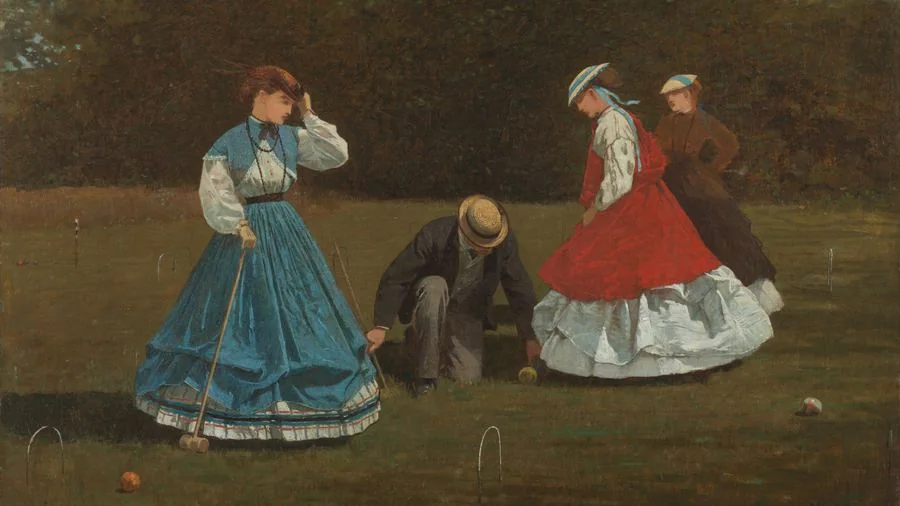
Croquet Scene is an oil painting by Winslow Homer from 1866, one of five pictures he made of the game. It shows women and men playing croquet on a sunlit lawn, and measures 40.3 by 66.2 cm. It hangs in Gallery 273 of the Art Institute of Chicago, which bought it in 1942.
Winslow Homer · 1866 · Oil on canvas · Impressionism · story written 25 September 2026
What you are looking at
The museum describes a game well advanced. A crouching man positions the ball belonging to the woman in red, who is about to croquet, or send up the country, another ball, probably that of the woman in the left foreground, who shields her eyes against the bright afternoon sun. Croquet had recently been introduced to the United States from the British Isles. The museum singles out the bold patterning, strong contours and brilliant light effects, and says the painting captures the spirit of a breezy summer afternoon.
How it was painted
Homer was born in Boston in 1836 and began his career as an illustrator during the Civil War. In the late 1860s he turned to oil painting, depicting figures bathed in sunlight out of doors; these early paintings, often made in series, show scenes of upper-class leisure. His uncle's mansion in Belmont, Massachusetts, the Homer House of 1853, inspired several of his croquet pictures of the 1860s. By then he had exhibited paintings every year at the National Academy of Design and been elected a full Academician in 1865.
Where it went
The painting belonged to William Sumner Appleton of Boston from 1871 until 1903, then to his son of the same name. C. C. Childes of Boston owned it by 1941, and in 1942 the Art Institute bought it through M. Knoedler and Co. in New York with the Friends of American Art Collection and the Goodman Fund. It was shown at the Macbeth Gallery in New York in 1937, in the Homer retrospective at the National Gallery of Art in Washington in 1958–59, and in Winslow Homer: The Croquet Game at Yale in 1984.
Why it is in Mura
It belongs to Mura's Coast and Countryside collection with a pastoral mood: bright dresses and a leisurely game on a shaded lawn.
Sources
- Art Institute of Chicago: Croquet Scene, object record · read 24 September 2026
- Wikipedia: Winslow Homer · read 24 September 2026
- Image record (Art Institute of Chicago) · Public domain / CC0
Mura is an art app for Apple TV and iPhone: museum masterworks by Monet, van Gogh, Hokusai, Turner and Renoir, shown one at a time, each with a story to listen to.
Get Mura for Apple TV