MURA · THE COLLECTION · HENRI EDMOND CROSS
Beach at Cabasson (Baigne-Cul)
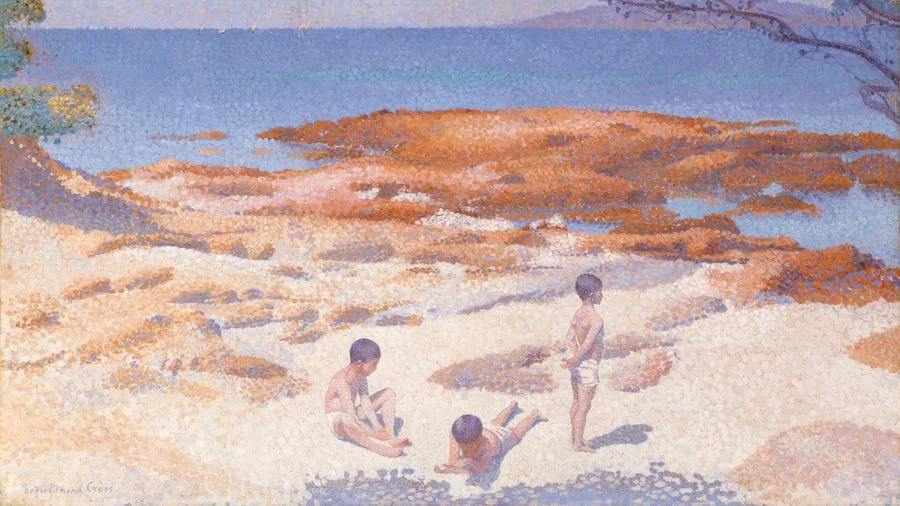
Beach at Cabasson (Baigne-Cul) is an oil painting by Henri Edmond Cross, made in 1891–92 shortly after he settled on the Mediterranean coast of France. It measures 65.3 by 92.3 cm and is one of his first pictures in the divided brushwork of Neo-Impressionism. It belongs to the Art Institute of Chicago.
Henri Edmond Cross · 1891–92 · Oil on canvas · Neo-Impressionism · story written 25 September 2026
What you are looking at
A beach at Cabasson, a hamlet on the Côte d'Azur near Le Lavandou, in the commune of Bormes-les-Mimosas in the Var. The museum says Cross used a systematic application of small dashes and dots of colour to convey the colour and heat of his adopted region. The catalogue entry describes pale sand and violet shadows meeting an orange shoreline and a still blue sea.
How it was painted
Cross was born Henri-Edmond-Joseph Delacroix in Douai in 1856 and changed his name in 1881 to avoid confusion with the Romantic painter Eugène Delacroix. He met Paul Signac on a trip to the Mediterranean in 1883 and in 1884 was among the founders of the Société des Artistes Indépendants, where he came to know Georges Seurat. For years he did not adopt their method; his work lightened gradually under the influence of Impressionism. He had wintered in the south since 1883, and in 1891, suffering from rheumatism, he moved there for good. His first home was at Cabasson, before he settled nearby at Saint-Clair for the rest of his life. The same year he began painting in the Neo-Impressionist style. The museum describes the move as a turning point: on the coast he embraced the divided brushwork and tonal gradations of what was called scientific Impressionism, a methodical technique that departed from the quick, intuitive strokes of the Impressionists. Signac moved to nearby Saint-Tropez in 1892. Cross died at Saint-Clair in 1910.
Where it went
The painting was shown at the Indépendants in Paris in 1892, at the exhibition of Neo-Impressionist painters at the Hôtel Brébant that winter, and with Les XX in Brussels in 1893. It belonged to Baron Eberhard von Bodenhausen-Degener in Munich, then to the Paris dealer Martin Fabiani, who sold it in 1951 to Fine Arts Associates in New York; it went the same year to Mrs. Vincent Astor and later to Mr. and Mrs. Werner E. Josten. Richard L. Feigen and Co. sold it to the Art Institute in 1983, where it was bought with the L. L. and A. S. Coburn and Bette and Neison Harris funds and the Charles H. and Mary F. S. Worcester Collection. It has since travelled to Tokyo, Fort Worth and Washington.
Why it is in Mura
It sits in Mura's Impressionist Life collection with a luminous mood: southern light broken into dots.
Sources
- Art Institute of Chicago: Beach at Cabasson (Baigne-Cul), object record · read 24 September 2026
- Wikipedia: Henri-Edmond Cross · read 24 September 2026
- Wikipedia: Bormes-les-Mimosas · read 24 September 2026
- Image record (Art Institute of Chicago) · Public domain / CC0
Mura is an art app for Apple TV and iPhone: museum masterworks by Monet, van Gogh, Hokusai, Turner and Renoir, shown one at a time, each with a story to listen to.
Get Mura for Apple TV